Star Power supports industrial and commercial clients with compliant temporary power solutions, including fuel storage that meets UK regulations and industry best practice. Our consultative approach ensures the storage set-up is practical, auditable, and cost-effective.
- What Regulations Apply to Fuel Storage?
- What Fuels Are Covered?
- Secondary Containment (Bunding) Requirements
- Separation Distances and Siting
- Fill Points, Dispensing and Overfill Protection
- Pipework, Hoses and Connections
- Venting, Fire Safety and Hazardous Area Control
- Spill Prevention and Pollution Control
- Inspection, Testing and Maintenance
- Labelling and Documentation
- Mobile Bowsers and Temporary Storage
- Integrating Storage with Generator Hire
- Plan Compliant Fuel Storage with Confidence
What Regulations Apply to Fuel Storage?
For industrial and commercial sites in England, compliance typically spans several frameworks. The Control of Pollution (Oil Storage) (England) Regulations 2001 require secondary containment for oil and diesel stored above 200 litres, usually through bunded tanks or integral containment (see GOV.UK: Oil storage regulations and safety).
Larger installations or specific activities may fall under the Environmental Permitting (England and Wales) Regulations, with guidance available from the Environment Agency on whether a permit is required
Health and safety duties, including risk assessment, hazardous area classification, and ignition source control, are covered by the Health and Safety at Work etc. Act and DSEAR; HSE’s DSEAR overview provides detailed direction.
Road transport is governed by ADR and the Carriage of Dangerous Goods rules; operator responsibilities are summarised at the link above.
For fixed installations, Building Regulations and relevant British Standards such as BS 799 (oil storage tanks) and BS 5410 (oil-firing systems) should be considered. Equivalent rules and guidance exist in Scotland, Wales, and Northern Ireland via SEPA, NRW, and NIEA, respectively.
Regulations and guidance change; check with the relevant regulator for the latest requirements and consult internal compliance teams for site-specific advice.
What Fuels Are Covered?
Typical products include diesel, gas oil, kerosene, and lubricating oils, with petrol and aviation fuels subject to stricter DSEAR controls due to higher volatility.
For generator hire, diesel and HVO (renewable paraffinic diesel) are most common. Unless a supplier specifies otherwise, HVO should be stored to the same standard as diesel.
Secondary Containment (Bunding) Requirements
Effective secondary containment remains central to pollution prevention. As a rule of thumb, bund capacity should be at least 110% of the largest tank or 25% of the total volume for multiple containers, whichever is greater.
The bund must be impermeable to oil, free of uncontrolled outlets, and have sealed penetrations. Rainwater should be removed through a controlled and documented process, and materials must be compatible with the stored product and any additives.
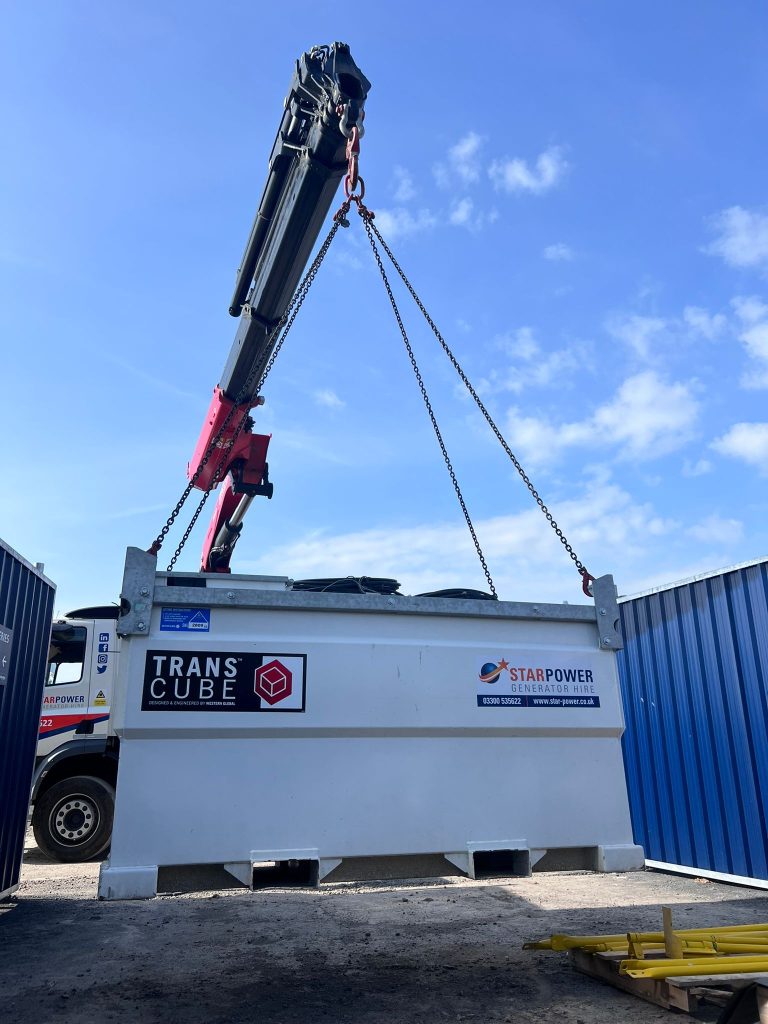
Tanks should be sited on a level, stable base and protected from vehicle impact and ground settlement. We supply bunded tanks and approved bowsers with certified containment that integrate cleanly with generator hire systems and temporary layouts.
Separation Distances and Siting
Appropriate siting reduces risks to people and the environment. Keep installations clear of watercourses, surface drains, soakaways, and flood-prone areas, following Environment Agency pollution-prevention guidance.
Controls at fill points, such as drip trays, sacrificial mats, and local spill measures, help prevent releases. Distances and zoning are determined through risk assessment and DSEAR classification.
Practical considerations include safe delivery routes, maintenance access, telemetry installation, and controlled refuelling points, with barriers or bollards where vehicle movements present collision risks. Our team coordinates siting with generator positions, cable routes, and traffic management after a site survey.
Fill Points, Dispensing and Overfill Protection
Fill points should be secure, clearly identified, and housed within built-in containment such as a cabinet or tray. Overfill prevention may include high-level alarms or automatic shut-off, supported by anti-siphon devices to prevent loss.
Isolation valves must be accessible yet guarded against accidental operation, and calibrated flow metering supports traceable records. Hose and nozzle selection should match the fuel and duty.
At Star Power, we integrate these controls within generator hire packages to enable safe, efficient refueling.
Pipework, Hoses and Connections
Pipework must be pressure-rated, adequately supported, and protected from mechanical damage. Above-ground routing is preferred to aid inspection; any underground lines should be double-walled or ducted and fitted with leak detection, with accurate as-built records maintained.
Flexible hoses require routine inspection and risk-based replacement in line with manufacturer guidance, while couplings and connectors benefit from guards and caps to prevent impact damage and contamination.
Venting, Fire Safety and Hazardous Area Control
Vents should be sized for expected fill rates and ambient conditions to avoid over- or under-pressure. Fire controls include no-smoking and ignition source policies, with hot work managed under a permit-to-work system.
Additionally, suitable foam extinguishers must be accessible, and routes for responders must be kept clear.
Hazardous areas must be classified in line with DSEAR, and equipment selected where applicable to ATEX requirements.
Spill Prevention and Pollution Control
Preparedness is essential. Sites should maintain spill kits scaled to stored volumes and ensure personnel are trained in their use. During deliveries, temporary drain covers or boom scans protect vulnerable drainage points. Emergency planning should define roles, escalation routes, and regulator notification thresholds.
Accurate records, including incident logs, corrective actions, and waste transfer notes, demonstrate duty of care.
It’s also important to note that regulations and guidance change; therefore, one must check with the relevant regulator for the latest requirements and verify site-specific procedures with internal compliance teams.
Inspection, Testing and Maintenance
Routine checks should cover leaks, corrosion, labelling, vent blockages, gauge faults, and bund integrity. Formal inspections are best set on risk-based intervals and may reflect insurer conditions. Instrumentation, including level gauges and high-level alarms, should be calibrated, and telemetry readings verified against manual measurements.
All findings, dates, and corrective actions should be documented for audits and insurer reviews. Our service includes telemetry, scheduled visits, and rapid response to protect uptime and demonstrate compliance.
Labelling and Documentation
Clear labelling supports safe operations and rapid response. Tanks should display:
- product type
- capacity
- hazard symbols
- emergency contact
Concise operating procedures, visible at the point of use, should cover deliveries, spill response, and emergency shutdown.
Typical documentation includes site and DSEAR risk assessments, COSHH information, delivery tickets, inspection and maintenance logs, and waste and incident records. Accurate, accessible records simplify regulator engagement and insurer surveys.
Mobile Bowsers and Temporary Storage
Mobile solutions must be UN-approved, bunded, and maintained per manufacturer standards. Position bowsers securely to prevent unauthorised movement and, where practicable, avoid high-traffic routes.
When moving on the road, ensure ADR/CDG compliance, appropriate driver competence, placarding where thresholds apply, and vehicle suitability. At Star Power, we provide approved bowsers and static tanks sized for generator hire, with safe transfer systems and audit-ready documentation.
Integrating Storage with Generator Hire
Right sizing the tank to the generator duty cycle reduces delivery frequency and improves stability. Telemetry provides real-time visibility of levels and consumption, improving planning and reducing stockouts.
Fuel quality controls, such as filtration and water separation, protect engines, particularly for long-term hire and variable ambient conditions. Hybrid options can reduce fuel burn, emissions, and delivery frequency without compromising resilience. Our focus is on the most economical methods for reliable temporary power while maintaining compliance.
Plan Compliant Fuel Storage with Confidence
We provide specialist temporary power solutions with compliant fuel storage for industrial and commercial operations. Arrange a site survey, receive a clear specification, and deploy a safe, auditable system that supports your programme.
Download our latest brochure or contact Star Power to discuss generator hire, approved fuel storage, and support services.

Our content reflects our commitment to reliability, safety, and practical knowledge - highlighting projects, service developments, and industry guidance designed to support your power needs.
